Zombie drug
The Door into SummerThe Zombie drug is an illegal substance developed in the United States’ investigation of brainwashing, and in Dan Davis’s confrontation with Miles Gentry and Belle it becomes a means of coercive control rather than a simple sedative. Dan remains awake and able to hear, see, and answer carefully framed questions, but loses the capacity to think and act on his own intentions. Belle exploits that divided condition to redirect his decisions, including making him agree to cold sleep after he had chosen against it.
Identity and Background
Dan later identifies the substance as the “zombie” drug and describes it as the United States’ answer to brainwashing. According to his account, the drug had been prepared during an investigation into brainwashing; as far as he knew, it had not been used on a prisoner. It was illegal, yet highly effective. Dan also says that the same substance was being used in one-day psychoanalysis and believes that even a psychiatrist required a court order to use it.
The distinction between its origins and its later use matters. The drug emerges from government research into the means of controlling a person’s mind, but Belle applies it in a private struggle over Dan’s resistance. Dan does not know where she obtained it, and his suspicion that she may have had other people under her influence remains conjectural. What he can establish from his own experience is its rapid bodily effect and its ability to leave a person outwardly present while undermining independent judgment.
Effects on Dan Davis
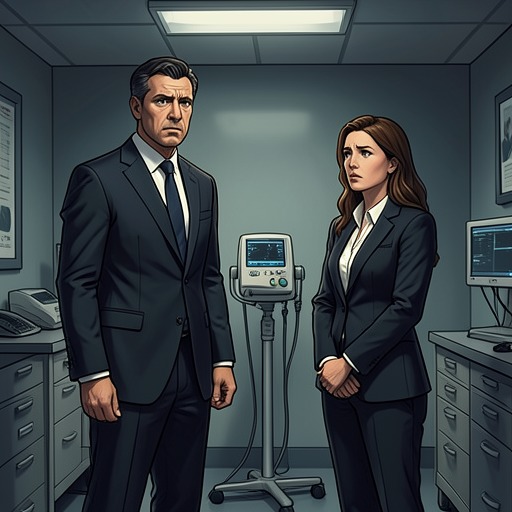
The drug takes hold quickly: Dan compares its onset to morphine and recalls dizziness and vagueness as his knees weakened. He does not become completely unconscious. Miles catches him as he begins to collapse and lowers him into a chair; as the dizziness passes, Dan remains physically aware of the scene around him. Yet he describes part of himself as dead, a forceful distinction between being awake and being able to exercise agency.
Dan can hear and see, but sensory access no longer leads to ordinary interest or response. He imagines that even a striking sight passing before him would not make him shift his eyes. This passivity is not simply sleepiness: he understands speech without caring about its content and cannot initiate an answer when Pete approaches and repeatedly demands to know what is wrong. Pete’s distress draws Miles and Belle’s attention, but Dan himself remains unable to participate in the exchange.
Belle explains the drug’s cognitive constraint when she questions Dan about the cold-sleep papers. Under its influence, she says, a person can hear, speak, and answer, but only when asked the right questions; the person cannot think. Dan’s ensuing account is therefore elicited rather than freely volunteered. Asked to start at the beginning and explain the cold-sleep arrangement, he recounts it in detail, including that he had decided not to proceed and had come to confront Miles and Belle. The drug permits a usable verbal response while leaving the subject unable to control the purpose to which that response is put.
Belle’s Use and the Cold-Sleep Command
Belle treats Dan’s drugged state as a way to settle the conflict in her favor. When Miles objects that the situation might amount to murder, she replies that Dan is now theirs and will do what she tells him. She describes a plan to command him not to sue, to stop interfering in their business, or even to go to Timbuktu; she also believes she can order him to forget what happened. Her confidence turns the drug’s impairment into an intended program of obedience, not merely a temporary incapacitation.
The cold-sleep papers give Belle a practical test of that control. After Dan explains that he had changed his mind and decided against cold sleep, she contradicts his choice and tells him that he wants it, will take it, and will let nothing stand in the way. Asked what he will do, Dan answers that he will take cold sleep. He begins to sway after standing rigidly for what he estimates may have been more than an hour, then slowly collapses toward Belle until she sharply orders him to sit. The sequence shows how the drug can govern both stated intention and bodily action: Dan’s words reverse his decision, while his immobility ends only when Belle gives a new instruction.
Belle’s later attempt to secure Dan’s signature on blank sheets reveals a further practical limit. He tries to comply, but his condition leaves him unable to write well enough for her purposes. She snatches the paper away and says she could sign his name better herself. The drug can make him willing to obey, but it does not guarantee that his impaired body can perform every task accurately. Belle then describes giving him an injection intended to make him feel better and move around as usual, while reinforcing the imposed relationship by telling him that she and Miles are his best friends and that she is his sister. Dan agrees that they are his best friends when asked. The episode shows the drug’s reach into both behavior and declarations of loyalty, without establishing that the claims he repeats are his own beliefs.
Limits and Narrative Significance
Belle recognizes that the drug’s commands may not permanently erase what the subject wants. She likens its effect to a posthypnotic command: Dan may carry out an order even when it conflicts with his real wishes. That conflict, she warns, could eventually bring him to a psychiatrist, who might discover the source of the trouble and help him get free of the instructions. Her explanation punctures her earlier certainty. She can make Dan act against his judgment, but the very distance between command and desire could expose the manipulation and create a route out of it.
The drug therefore operates through a sharp split between consciousness and agency. Dan is no absent or unconscious body: he hears the discussion of what is being done to him, understands Belle’s questions, and later recounts the episode. But awareness alone cannot protect him when he cannot think, refuse, or act in accordance with his settled choice. The suspense comes from that gap—his mind can register the coercion while his speech and movements are made to serve it.
As an object in the conflict, the Zombie drug makes the familiar act of answering a question politically and morally unstable. Dan’s account of his cold-sleep decision sounds like testimony, yet Belle controls the question and uses the answer to impose the opposite choice. His apparent agreement is consequently not evidence of consent. The drug gives Miles and Belle a temporary means of overriding Dan, while its potential conflict with his own wishes makes their control less secure than Belle claims.